
If you're hauling for the first time, or hauling a new type of toy, determining what length of ratchet strap to buy can feel daunting. Is a 6' strap too short? Is a 30' strap too long? Is a 1,000 lb. working load limit enough? And what does working load limit mean? One of the questions we hear the most is "What length ratchet strap do I need?". For drivers that are moving a car, motorcycle, ATV or other vehicle, your direct-to-anchor trailer setup can be calculated in a practical way so that you're not buying straps that are too long, too short, or not strong enough.
Our guide will help you understand why different types of cargo require different lengths, and the key factors to take into consideration when choosing the length that's right for your hauling needed.
Tying Down Static Cargo vs Vehicles: The Difference Between Them
You will need longer straps to tie down a fridge or load of lumber than you will a motorcycle, ATV or car. Part of the reason is because vehicles must be secured (by law, in most states) at all four corners, which greatly reduces the length of the strap you need... but increases the number of total straps you need to four.
Ratchet Strap Length for Static Loads
Measure Your Cargo's Dimensions
The first step in determining the what strap length you need is to measure your cargo's dimensions. You need to know how long, wide, and tall your load is. Take these measurements accurately, and make sure to account for any protruding parts or irregular shapes.
Once you have these measurements, you can use them to estimate the length of the ratchet straps you'll need. In general, you'll want straps that are at least 1.5 times the length of your cargo to ensure you have enough length to secure it effectively.
Identify the Number and Location of Tie-Down Points
The number of tie-down points or anchor points on your cargo also plays a role in determining the best length for ratchet straps. If your load has multiple anchor points, like rings, hooks, or loops, you may need longer straps to reach and secure each point effectively. You'll need to distribute the tension evenly across all the anchor points to ensure a secure and balanced load. Longer straps make this possible, allowing you to connect each anchor point to a separate strap for optimal security.
Consider the Type of Vehicle and Trailer
The vehicle or trailer you're using to transport your cargo can influence the best length for your ratchet straps. Consider these factors:
- Truck Bed Length: If you're securing cargo in a pickup truck bed, the length of the bed can dictate the strap length you need. Longer truck beds may require longer straps to reach from one end to the other.
- Trailer Size: Trailers come in various sizes, from compact utility trailers to large enclosed trailers. The size of your trailer will impact the length of the ratchet straps you require. Larger trailers often need longer straps to accommodate more substantial loads.
- Attachment Points: Different vehicles and trailers may have varying configurations of anchor points or attachment options. Ensure that your chosen strap length matches the setup on your specific vehicle or trailer.
Consider Overhang
When securing cargo with overhanging portions, like lumber or pipes, it's crucial to account for the overhang when selecting the length of your ratchet straps. You must secure both the main portion of the load and any overhanging elements adequately.
Start by calculating the total length of the cargo, including the overhang. Then, choose ratchet straps that can cover the entire length, ensuring that both the main load and overhanging parts are secure.
Ratchet Strap Length for Motorcycles, ATVs, UTVs, Cars
Measure the Strap Path
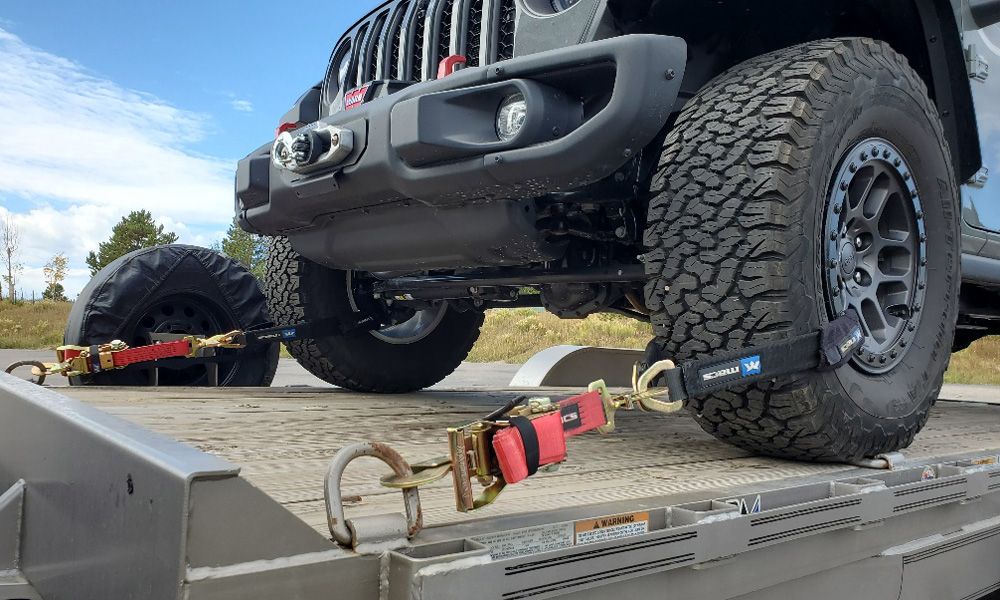
Measure from the vehicle attachment points to the trailer anchor points and add adjustment room. Note that a strap that is too short will not reach, while one that is too long leaves excess webbing to manage. Keep in mind if you're using soft loops, which will add about a foot of length, and if you will need to move the ratchet out from under a wheel well, as a direct hook option will give you better access to the ratchet.

The Three Measurements That Control Strap Length
A. The distance from the vehicle anchor point to the trailer anchor point, which may also include the length of strap that will wrap around a tire.
B. Length of the ratchet mechanism, which may also include a sewn fixed end
C. Usable tail or webbing that comes out of the end.
A fast formula for direct-to-anchor setups
For direct tie-down use, measure from the vehicle attachment points to the trailer anchor points and add adjustment room. Note that a strap that is too short will not reach, while one that is too long leaves excess webbing to manage. Keep in mind if you're using soft loops, which will add about a foot of length, and if you will need to move the ratchet out from under a wheel well, as a direct hook option will give you better access to the ratchet.
Why anchor point position changes everything
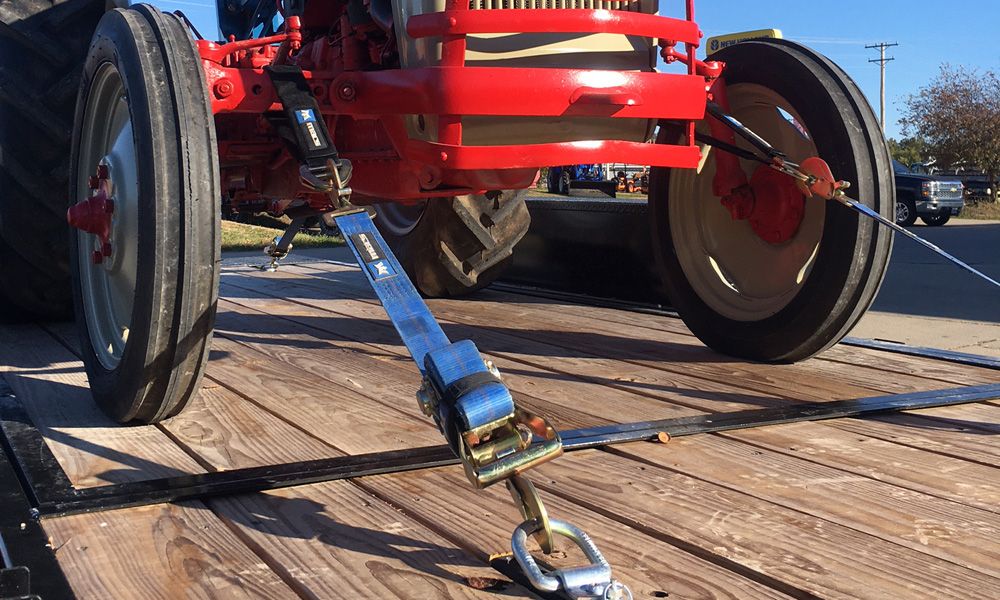
Where your anchor point are affects how long your straps need to be. If you have built-in track or rail down the sides of your trailer, that could increase the total distance from the anchor point on the vehicle to that track anchor point on your trailer. A low anchor point often needs more strap than a side rail anchor point. A wide trailer with far-spaced attachment points also increases the total path.

Match strap length to what you are hauling
If you're hauling a motorcycle trailer, you don't need a 27' strap. Could you use it? Yeah, however there's going to be a lot of loose webbing to roll up and out of the way when it's time to drive. Longer lengths are better suited to those who transport a variety of cargo on a utility trailer, including furniture, material for jobsites, pallets of goods, and other loads that might require that the length of strap pass fully over or around the cargo.
Motorcycle: Soft loops over the handlebars, front tire in a chock, and four 1" x 10' straps to reach from the soft loops down to the anchor point on the trailer.
ATV/UTV: Either adjustable tire nets to secure each tire in place, or four 2" x 8' ratchet straps that include an integrated axle strap.
Classic car: Four 2" x 6' straps that include an integrated axle strap and a direct hook ratchet mechanism so that the ratchet isn't awkwardly positioned under the bumper. Secures to D-ring anchor points at either end of the trailer.
Secondhand cabinets you picked up from a stranger at a good price: Blankets to protect the cabinets, extra cardboard where the straps go over a corner, 1" x 16' ratchet straps that pass over the cabinets and secure on either side of the trailer.
Short, Medium and Long Straps: Understanding Use Cases for Each
When shorter straps work better
If your vehicle is close to your anchor point, especially on trailers that are made for hauling cars, ATVs or motorcycles, a short strap like a 6' or 8' length means less loose webbing, faster set up times and a cleaner tie down set up overall.
When medium and long straps make sense
When you get into longer sizes such as 10', 16' or greater, that's when you have longer distances to cover between the load and the tie down point, or you have a load that isn't a vehicle and needs the full width of strap to secure it. Think fridge, cabinets, generator, anything that might be transported on a utility trailer or in a pick-up truck bed. Those sizes also work if you're transporting a small vehicle (motorcycle or ATV) on a wider trailer that's normally used for something like car transport.
The most common mistake: buying for cargo size but not strap path
Longer and stronger isn't always the best way to think about buying a strap. The better method is to choose based on the full strap path rather than the size and mass of the load. A motorcycle actually probably needs less strap than a bulky cooler, even if the cooler weighs less.
Double Check Width, Working Load Limit (WLL) and Strap Count
- 1" Straps work for most light cargo, dirt bikes and small to medium motorcycles
- 2" Straps work for large motorcycles, ATVs, UTVs, cars and heavy cargo
Working Load Limit (also called Work Load Limit) refers to the maximum safe weight or force that a ratchet strap is designed to handle during normal, everyday use. The snapping point of the strap called the Breaking Strength (or Break Strength), and it's usually about 3 times higher than the WLL.
The Combined Working Load Limit Of All Straps Must Equal At Least 50% of Cargo Weight
Per FMSCA Cargo Securement Rules, the total combined WLL of all your tie-downs must equal at least 50% of the weight of the cargo being transported.
What this means, is that is your trailer load weighs 4,000 lbs., your combined strap WLL must be at east 2,000 lbs. For vehicles, which require straps in all four corners, each individual strap needs a WLL equal to 25% of the vehicle's weight. However, most professional haulers use straps with a WLL equal to or greater than 50% of the vehicle's weight as a safeguard. That way, if one strap happens to fail, the remaining straps can still safely hold the load.
Recommended Strap Ratings by Car Weight
- Light Cars (under 3,000 lbs.): Use 2" straps with a WLL of at least 2,000 lb. each.
- Medium Cars/Small SUVs (3,000 to 5,000 lbs): Use 2" heavy-duty straps with a WLL of at least 3,300 lb. each.
- Heavy Trucks/Large SUVs (over 5,000 lbs): Use heavy-duty 2" or 3" straps with a WLL of 5,000 lb. each, or switch to transport chains.
Rule of Thumb For Buying the Right Size the First Time
For static cargo: Measure the full path, add working allowance, then choose the shortest strap that still gives safe adjustment room.
For vehicles: Measure the distance from anchor point to tie-down point on the vehicle at all four corners, then choose a four pack of straps that matches, or is greater than, the longest length.
Discover Quality Ratchet Straps at Mac's Custom Tie-Downs
No matter the length of ratchet straps you choose, quality matters. Cheap or poorly made straps can compromise your cargo's safety and your peace of mind. Ensure you invest in high-quality ratchet straps that are designed to meet industry standards and withstand the demands of your cargo securing needs.
Mac's Custom Tie-Downs makes ratchet straps you can depend on. Our wide-ranging inventory is designed with precision and durability in mind. They’re crafted to meet or exceed industry standards, ensuring the safety and security of your cargo during transport.
With Mac's Custom Tie-Downs, you can trust that you're getting ratchet straps that are up to the task, no matter the size or type of cargo you're securing. Whether you need shorter straps for small loads or longer ones for oversized equipment, we have you covered. Need help? Reach out to our dedicated team to find the right straps for your applications.


